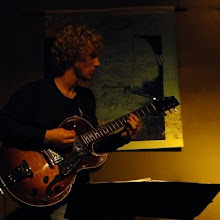
Lionel Loueke grew up in what he has described as a family of poor intellectuals in the West African country of Benin. He began playing percussion instruments around the age of 9, but was influenced by an older brother who played guitar, which he began playing himself in his late teens. It took Loueke a year to earn the $50 he needed to buy his first guitar. However, he could not afford to replace the strings, which had to be special-ordered from Nigeria. Instead, he soaked his strings in vinegar to keep them clean. When the strings broke, he had to replace them with bicycle brake cables that were very hard on his fingers. Loueke got his first professional job by accident; when a club manager heard him playing a guitar he had grabbed off the bandstand during a break and offered him work. He played African pop music, but discovered jazz when a friend returned from Paris with a copy of an album by jazz guitarist George Benson.
This inspired Loueke to study jazz in Paris. He then won a scholarship to study at the Berklee School of Music in Boston. In 2001, Loueke auditioned for the Thelonious Monk Institute of Jazz at the University of Southern California. He was selected in a worldwide search by a panel of judges including jazz musicians Herbie Hancock, Terence Blanchard and Wayne Shorter. He attended the Thelonious Monk Institute of Jazz until 2003.
In 2002, while still at the Thelonious Monk Institute, Loueke began playing with trumpeter Blanchard. Loueke was featured on two albums with Blanchard for Blue Note Records, Bounce (2003) and Flow (2005). He subsequently has had a prolific career as a sideman. He has performed on jazz pianist Herbie Hancock’s albums Possibilities (2006) and River: The Joni Letters (2007), and also worked with Kenwood Dennard, George Garzone, Bob Hurst, Alphonso Jonhson, Angelique Kidjo, Dianne Reeves, Cassandra Wilson, Wayne Shorter, Jeff 'Tain' Watts, Charlie Haden, Richard Bona, Nathan East, Vinnie Colaiuta, Marcus Miller, Sting, Brian Blade, John Patitucci, Terri Lyne Carrington, Kenny Garrett, Roy Hargrove, Santana, Dennis Chambers, Magos Herrera, and Gretchen Parlato.
Loueke formed the trio Gilfema with Massimo Biolcati (bass) and Ferenc Nemeth (drums), classmates from the Berklee College of Music, and released two albums on the ObliqSound label: Gilfema (2005), and Gilfema + 2 (2008), featuring clarinet players Anat Cohen and John Ellis. Under his own name, Loueke recorded the live album In a Trance in 2005, and Virgin Forest, which was released by ObliqSound in 2006.
Loueke made his major-label debut in 2008, when Blue Note released his album Karibu. NPR.org praised the guitarist for his fusion of traditional African music with modern jazz harmonies, unique vocal inflections, and complex time signatures. The album features Biolcati and Nemeth, as well as guest appearances by Hancock and Shorter. His latest album, Mwaliko (2010), is a collection of duo and trio performances that mixes traditional West African music and jazz. Guests include fellow Benin native Kidjo, Cameroonian bassist and singer Richard Bona, bassist Esperanza Spalding, and drummer Marcus Gilmore, doing a version of Shorter’s classic composition "Nefertiti".
In early 2008, Loueke's "Kponnon Kpété" won in The 7th Annual Independent Music Awards for Best Traditional World Song.
Though Jack DeJohnette may be known to most as one of the preeminent jazz drummers, making notable contributions to groups led by Charles Lloyd, Miles Davis, and Keith Jarrett, he sees himself as a messenger of peace and joy. Whether on drums, piano, or any other instrument, DeJohnette would most like to give people the inspiration to relax and find happiness in life, if only for the time they’re listening.
He originally fell in love with music through his uncle, Roy Wood, one of the first African-American disc jockeys in Chicago. He fondly remembers sitting by his uncle’s Victrola: cranking it up and then dropping the needle, with an “arm that weighed about ten pounds.” They’d listen to the great big bands of Duke Ellington, Tommy Dorsey, Benny Goodman, and Count Basie.
By the time DeJohnette was in high school, his uncle had moved to a jazz station, and he got to hear all the latest records as they came out. By that time, Jack had been singing lead in a doo-wop group, regularly competing in talent shows and playing in local dives, but he was inspired by the hip new jazz he heard through his uncle. DeJohnette remembers that back then, “it was cool to have jazz records in high school.”
As he became more invested in music, Jack found new outlets for his talent, playing piano in jazz and dance groups; and, in a real stroke of luck, the drummer from one of these bands left his kit at DeJohnette’s house once for several months, and he began to mess around on them in his spare time. He’d always been interested in the instrument and studied the drummers at jam sessions. With his interest growing, he got a few books and began to practice rudiments while watching television.
The work soon payed off as he started getting hired to play gigs on both piano and drums. It was after playing a bit with Eddie Harris that he finally decided to make drums his primary instrument. Harris told him one night after a gig, ‘you play good piano, but something else is happening on the drums. I play all the other instruments too, but I have to make one instrument be my voice. If you decide to stay with drums, make drums your main voice. You’re gonna be something and go somewhere.’
Working around Chicago and hanging at the clubs, DeJohnette took every opportunity he could to hang with the major artists who came through the city. Among these was John Coltrane, who played at a small club where DeJohnette regularly went to jam. When Elvin Jones didn’t show for the last set, the owner suggested the DeJohnette sit in. Coltrane and the other musicians didn’t bat an eye, and DeJohnette fit right in on “I Want To Talk About You” and “Mr. P.C.” During the set, he realized why Jones was so forceful on the drums, as Coltrane just “soaked up all of the energy and barreled forward like a train.” To his dismay, Jones showed up just in time to play “My Favorite Things,” thanking the young drummer for filling in.
It was Muhal Richard Abrams who pushed DeJohnette to take the leap and head to New York in 1964. As DeJohnette recalled, “a lot of people were afraid to come to New York because it was the big apple and really rough, and he just said ‘don’t worry. It’s just like Chicago, only more of it.’”
With that, DeJohnette took off on a Greyhound bus, taking only $27 and a Gretsch set of drums and cymbals with no cases. He’d initially only planned to stay for a weekend, but in that weekend, he went to Minton’s, jammed with Freddie Hubbard--whom he’d met when the Jazz Messengers came through Chicago–and was noticed by organist John Patton, who offered him a gig on the spot. With that boost to his confidence, DeJohnette felt he could make it, and decided to stay in New York indefinitely.
He became a regular at plenty of jam sessions, and as word got around that there was a hot new drummer in town, he began to get regular work. Within a few weeks, DeJohnette had enough money to get his own apartment on the Lower East Side.
His first big gig was in Jackie McLean’s band, playing week-long stands around the country in cities like Baltimore and Pittsburgh, promoting McLean’s latest record release.
DeJohnette soon got a chance to play with Coltrane’s new avant-garde group featuring Coltrane’s wife Alice, Pharoah Saunders, Jimmy Garrison, and Rasheed Ali. It was one of the most intense gigs he played in his life, and he found that Coltrane , and others of that generation, like Miles Davis, Sonny Rollins, and Thelonious Monk, never gave much direction. “Not that much was talked about in the music. There was just an inner-knowing about things. The younger generation now is more accessible, but guys didn’t talk that much about it because they figured if you talked too much about it, you’d de-mystify it.”
Even on groundbreaking material like Bitches Brew, he found the music was a continual work in progress. Miles Davis would come in with a few sketches, or he’d ask DeJohnette to play a beat, and if Davis “didn’t say anything about it, it was okay. Most of the time he didn’t say anything.” Once the groove was where Davis wanted it to be, he’d direct somebody else to join in, and the music slowly came together in a free-flowing environment before being spliced into it’s final form by producer Teo Macero.
While Davis was putting together a distinct new sound, DeJohnette credited concert promoter Bill Graham for spreading their music to a wider audience by placing the Davis group on mixed bills at the Fillmore with such acts as Janis Joplin and the Paul Butterfield Blues Band. Then at the same time there was the advent of FM radio, which in those days was “wide open, and they started mixing up the music. They would play some Miles. They would play some Laura Nyro. They would play Jimi Hendrix.”
In fact, DeJohnette became a real admirer of the Jimi Hendrix Experience. He extolled the talents of drummer Mitch Mitchell and praised his use of brushes on tunes like “Up From The Skies,” from the Experience’s Axis: Bold As Love. He even got a chance to jam with Hendrix “about a week before the Isle of Wight,” less than a month before his death. Sadly, DeJohnette wasn’t really in the mood at the time, and he passed on the opportunity, which he has been kicking himself for ever since.
Some of DeJohnette’s most memorable music has come playing in piano trios with Bill Evans and Keith Jarrett. Having started as a pianist himself, hiring drummers to play with him, DeJohnette gained an understanding of what drummers can do for a soloist. “I kind of know what the drummer’s supposed to do, at least for myself anyway. It’s just about learning how to wait, and listen, and letting the music carry you, rather than trying to force something to happen.”
DeJohnette has also gotten into producing music through his own imprint, Golden Beams Productions. Inspired by Coltrane’s readings of Eastern philosophy and beliefs that music had a power for good, DeJohnette has used the label to put out music to be used as a healing force. “When you’re playing music, it’s more than entertainment. It has the ability to transport the player and the listener to some other places, so you can for an hour or so, relieve people of some stress and lift up their spirits through the music.”
The label has allowed DeJohnette the chance to experiment with genres and musicians he likes outside of the jazz idiom. The first of these recordings was Music In The Key Of Om, an hour-long synthesizer-driven piece, which has since been well circulated through yoga classes and hospitals throughout the country, helping people to relax. The second was Music From The Hearts Of The Masters, with Gambian kora player Foday Musa, a more groove-oriented album of duets soothing duets.
As DeJohnette continues to pursue new endeavors in music, he hopes to spread joy to all willing listeners. “If you can find a way to have joy when you make the music, you’re going to have something to give to the people to lift them up.”
Here are some extra anecdotes from the interview where Jack DeJohnette talks about playing with Sting and going to see Charles Mingus:
Christian McBride was born on May 31, 1972 in Philadelphia. Electric bass was Christian's first instrument, which he began playing at age 9, followed by acoustic bass two years later. His first mentors on the instrument were his father, Lee Smith (a renowned bassist in Philly) and his great uncle, Howard Cooper (a disciple of the jazz avant-garde).
While intensely studying classical music, Christian's love for jazz also blossomed. Upon his 1989 graduation from Philadelphia's fertile High School for the Creative and Performing Arts (C.A.P.A.), Christian was awarded a partial scholarship to attend the world-renowned Juilliard School in New York City to study with the legendary bassist, Homer Mensch. That summer, before making the move to the Big Apple, the already in-demand bassist got his first taste of touring, going to Europe with the Philadelphia Youth Orchestra, and traveling the U.S. with the classical jazz fusion group, Free Flight.
McBride never had a chance to settle into his Juilliard studies. Within the first two weeks of the semester, he joined saxophonist Bobby Watson's band, Horizon. He also started working around New York at clubs such as Bradley's and the Village Gate with John Hicks, Kenny Barron, Larry Willis and Gary Bartz. After one year at Juilliard, McBride made a critical decision to leave school to tour with trumpeter Roy Hargrove's first band, electing "experience with as many musicians as possible" as the best teacher. In August of 1990, he landed a coveted position in trumpeter Freddie Hubbard's band, which lasted until January of 1993.
In 1991, legendary bassist Ray Brown invited the young wunderkind to join him and John Clayton in the trio SuperBass. After being hailed “Hot Jazz Artist” of 1992 by Rolling Stone, Christian continued to prove it as a member of guitarist Pat Metheny's "Special Quartet," which included drum master Billy Higgins and saxophonist Joshua Redman. While recording and touring with Redman the following year, McBride signed to Verve Records in the summer of 1994, recording his first CD as a leader, Gettin' to It. He also graced the big screen playing bass in director Robert Altman's 1940's period piece, Kansas City (1996).
Christian recorded three more career-shaping albums at Verve: Number Two Express (1996), the soul-jazz fusion project A Family Affair (1998 – featuring Christian’s first two songs as a lyricist), and the critically acclaimed SCI-FI (2000), marking the inaugural execution of Christian’s concept of music being boundless by genre. The following year, he continued to expand his audience with two endeavors. He dipped into hip hop with a side project dubbed The Philadelphia Experiment, a “jam band”-inspired CD that reunited Christian with his high school friend, drummer Ahmir “?uestlove” Thompson (leader of The Roots) and featured keyboardist Uri Caine and guitarist Pat Martino.
Later that year, pop star Sting invited Christian to become a key figure in his 2001 All This Time CD, DVD and tour. Then in 2002, Christian supported George Duke by becoming a member of his band and recording on his landmark album Face the Music: the legendary keyboardist’s first album on his own recording label, BPM. “Christian is a monster on that bass,” Duke states with pride. “It isn’t often these days to find a young musician so dedicated to his craft. Christian is my kind of musician, one that is open to new ideas, good at playing different styles, reads music prolifically and is dedicated to furthering the growth of music not only as a musician, but as a young representative of his profession. There isn’t anyone better. And besides that, he’s a great cat!”
There have been very few artists who truly embody the genuine, heart-felt passion for music in all areas as has Christian McBride. By boldly continuing to leave his mark in areas of musical performance, composition, education and advocacy, he is destined to be a force in music for decades to come.
Since the landmark release of Giant Steps, musicians have struggled to explain how John Coltrane created his trademark "sheets of sound." In his new DVD, George Garzone, successfully does just that with his "triadic-chromatic" approach to improvising.
Garzone's new concept for improvisation is a product of more than twenty-five years of teaching at such institutions as the Berklee College of Music, The New England Conservatory, The Manhattan School of Music, and New York University. While his playing today may be classified as avante-garde, Garzone came from modest beginnings, learning the art of swing in the back of a pizza parlor.
Growing up in Boston, Garzone began playing to carry on the family tradition, including a fat sound that he credits as an heirloom of his Calabrian descent. His earliest influence was his Uncle Rocco, a successful tenor saxophonist who'd worked in various big bands during the thirties and forties but gave up music to settle down. In order to support his family, Rocco set up a pizza shop, (Rocco’s Pizza, located at Norfolk and Geneva in Boston’s Dorchester neighborhood,) which went on to become a Boston institution unto itself.
George would come by every week, and his uncle would school him in the fundamentals of music, and introduce him to artists like Stan Getz, but it was the Italian culture of romantic music, which so influenced the "family sound" he inherited. Garzone still repeats the words of his uncle, who spoke of "romancing the instrument" and “sensualizing the sound.” As he told the audience, the "sound comes from life experience," likening his uncle's vibrato to something "that you could cut cheese with.”
Eventually, Uncle Rocco realized that his student had outgrown his instruction, and convinced his old friend Joe Viola to take the 15 year-old under his wing. Viola had founded the Berklee College of Music’s Woodwind Department, and taught only their most advanced students, but the relationship was immediately fruitful. “Joe was a guru,” Garzone said. “You could learn just by sitting next to him.”
Garzone officially enrolled at Berklee in 1968, encountering young hotshots like Kenny Werner, Dave Liebman and Steve Grossman, but it was a seventeen year-old Joe Lovano who really blew him away. He first saw Lovano playing in Herb Pomeroy’s band, and recalled, "I never heard anyone play like that before. Joe was playing, and we all left literally crying. I was in tears because I had never experienced music like that."
Shortly thereafter, the two were practicing Coltrane's "Giant Steps" in adjacent practice rooms at Berklee when Lovano literally kicked open the door and grilled him, asking, 'man, what are you practicing?' Garzone, stumped for how to respond, replied with the same question, at which point Lovano introduced himself, beginning a lifelong friendship.
A few years later, fresh out of college, Garzone went on tour with Tom Jones, stopping in Cleveland, where Lovano invited him over to his family's house for a wonderful Italian meal. Garzone "can still smell the tomato sauce" from when he walked in the door.
After the large meal, Garzone was ready to plop on the couch and watch television, but Lovano invited him down to the basement where they jammed along with Lovano's father, "Big T," one of Cleveland's top tenor players. "It was Joe on one side and Big T on the other. We started playing bebop tunes and blues, and they were so intense that they just squeezed me out of there. I couldn't hang with it, and I watched father and son go at it. It was a spectacular moment for me, to see something like that: dad and son, schooling the kid."
After a year in Tom Jones' band, Garzone was stuck back in Boston and in need of work. There he formed his long-running band, The Fringe, with drummer Bob Gullotti and bassist John Lockwood, who also got him a gig teaching at Berklee in the ensemble department.
Eventually he worked his way into teaching saxophone department, and there he began to develop his triadic chromatic approach to improvisation. "This concept, the triadic-chromatic approach, is really coming from Coltrane, but it's something the students really helped me develop because they would come and listen to my band The Fringe every week, improvising freely, and they would ask me, 'how do we do this?' So I had to figure out how I could give them a very layman's version of how to do something that I didn't even know how to do."
As Garzone's reputation grew, he began teaching at multiple institutions in New York and Boston on a weekly basis. It was in his regular drives between the two cities that Garzone listened more closely to Coltrane and discovered "subliminal messages that he left in his improvisation that were very triad-oriented."
Teaching at these schools, Garzone worked with many young virtuosos, whom he needed to give new material to. "When you have students like Mark Turner, Seamus Blake, Donny McAslin, Branford Marsalis, they're already playing, so you need to go in and find something that challenges them, and that's what I did through figuring out this concept because of these high-level players I've had. These kids can really play. Especially today, I'm dealing with people that can go neck and neck with me on a gig, but the only thing that gets them is this: major triads with half-steps in between, random inversions, don't repeat yourself. That gets them."
It was one student, guitarist Chris Crocco, who really pushed Garzone to clearly formulate and organize his triadic chromatic approach. Crocco studied with Garzone every week for seven years during the nineties, and in Garzone's estimation, he is the only other person, besides himself, who is really fluent in the triadic chromatic vocabulary. The two demonstrate and outline this concept in a brilliant lesson format on Garzone's new DVD: The Music Of George Garzone & The Triadic Chromatic Approach.
While his name may not ring out in the pantheon of jazz tenor players in the way that John Coltrane's does, Garzone's influence on the jazz scene, through the proliferation of his ideas, is immeasurable.
George Garzone plays the standard "I Want To Talk About You," inspired by John Coltrane's rendition, and then speaks about his approach to saxophone and unraveling Coltrane.
Born in Chicago in 1942, Jack DeJohnette is widely regarded as one of jazz music's greatest drummers. He began studying classical piano at the age four, continuing until he was fourteen before starting to play drums with his high school concert band.
In his early years on the Chicago scene, he led his own groups and was equally in demand as a pianist and as a drummer. He played R & B, hard bop, and avant-garde and was active with the experimentalists of the AACM in its early days, with the likes of founder Muhal Richard Abrams, Roscoe Mitchell, and Joseph Jarman. In 1966, he drummed alongside Rashied Ali in the John Coltrane Quintet.
International recognition came with his tenure in the Charles Lloyd Quartet, one of the first jazz groups to receive cross-over attention, also alerting the world to Keith Jarrett's skills. Jack DeJohnette has collaborated with most of the major figures in jazz history including John Coltrane, Miles Davis, Ornette Coleman, Sonny Rollins, Sun Ra, Jackie McLean, Thelonious Monk, Bill Evans, Stan Getz, Keith Jarrett, Chet Baker, George Benson, Stanley Turrentine, Ron Carter, Lee Morgan, Charles Lloyd, Herbie Hancock, Dave Holland, Joe Henderson, Freddie Hubbard, Abbey Lincoln, Betty Carter and Eddie Harris, who is responsible for convincing DeJohnette to stick with drums because he heard DeJohnette's natural talent.
It was in 1968 that DeJohnette joined Miles Davis's group in time for the epochal upheaval marked by Bitches Brew, an album that changed the direction of jazz. In his autobiography, Miles Davis said, "Jack DeJohnette gave me a deep groove that I just loved to play over."
Miles also brought about collaborations with John McLaughlin, Chick Corea and Dave Holland. In 1968 he recorded his first album as a leader on the Milestone label, called The DeJohnette Complex, where Jack played melodica along with his mentor Roy Haynes on drums.
Jack began to record as a leader for ECM, with each of his successive groups Directions, New Directions, and Special Edition making important contributions to the evolution of jazz. The New Directions band featured two musicians who would have long-term associations with DeJohnette: John Abercrombie and Lester Bowie. A friend from his Chicago days, Bowie played intermittently with DeJohnette until the end of his life. Most notably, Lester and Jack collaborated on a duo album called Zebra, which was a world beat influenced video soundtrack and CD.
While continuing to lead his own projects and bands, DeJohnette has also been a 25-year member of the immensely popular Keith Jarrett/Gary Peacock/Jack DeJohnette Trio and appeared on more ECM albums than any other musician.
DeJohnette’s latest release is Peace Time, an hour-long continuous piece of music composed and performed by Jack: “flights of flute, soft hand drumming and the gently percolating chime of cymbal play, moving the piece along a river of meditative delight. Subdued layers of overtone singing and the distant drones of sitars waft in and out like comforting and familiar spirit guides that manifest themselves in sound.” (eMusic)
Here is a clip of Jack DeJohnette playing with Keith Jarrett and Gary Peacock in 1985:
John Abercrombie took quite a while to find his way in the musical world. A defining artist of the ECM record label, best known for his work with Billy Cobham , but growing up in Greenwich, Connecticut in the 1950's, it wasn't until around the age of nine that he started consciously listening to music.
It would be several more years before he discovered jazz, but he was first drawn to artists like Fats Domino and Chuck Berry. Years later he realized a connection. ”The thing about that music that I always found interesting was, when I went back to it, years later, I still found that I liked it because there was something still connected to jazz about it that I thought later music wasn’t. Some of the players were really good. Some were probably aspiring jazz players at the time and they wound up in these rhythm and blues bands.”
Right from the start, Abercrombie found he was particularly “attracted to the sound of the electric guitar... I didn’t know the difference between an electric and acoustic guitar. I didn’t even know what electricity was, but I know there was something about the electric guitar, or that sound I was hearing on records that drew me in.”
Noticing his interest, John’s parents bought him a cheap acoustic guitar for forty-nine dollars, but the steel strings always hurt his fingers. He says it was such an awful instrument that he "actually used it to play baseball a few times. I didn’t have a bat; 'well, I’ll use my guitar.'”
Surprisingly, Abercrombie's first encounters with jazz came through the Perry Como television program. Como “was a very low-key kind of a singer. He looked like he was going to die as he was singing. He was beyond mellow, but he had kind of a nice quality to his voice, and there was always a section of his show that was called ‘Dear Perry: Dear Perry would you be so kind to fill a request and sing the song I like best.’ Perry would waddle out, and behind him there was a guitar player on a stool with just a Gibson guitar plugged into an amplifier, and the guy was Tony Mottola.”
What grabbed John’s attention was the pretty chords that Mottola was playing, and he asked his teacher to show him what he was hearing. Note for note, he learned chord-melody renditions of standards like "Tenderly" and "Misty." He recalled that, he didn’t really know what he was doing, “but, like most guitar players, I just knew that if I put my fingers like this, and I did that, I got a sound.”
Eventually, jazz came along as a revelation when some friends played him Barney Kessel. To John’s ear, Kessel's bluesy bebop wasn't a big stretch from the Chuck Berry licks he was familiar with. From there came the music of Dave Brubeck and Miles Davis, which he found equally inspiring.
As the 1960's began, Abercrombie started making regular pilgrimages to New York to see jazz at the legendary Birdland club, even though sometimes he wasn’t quite ready for what he was hearing. Once he saw a double bill of the Bill Evans Trio (possibly with Scott LaFaro) and the John Coltrane Quintet with Eric Dolphy in 1961, and John remembers thinking at the time that Evans was "too tinkly: like cocktail lounge music," while Coltrane was "too far out." Of course, later on, both became great influences of his.
Abercrombie's first serious study of jazz came at the Berklee School of Music, where he worked with first-year teacher Jack Peterson. Just as John was trying to find his way in the music, Peterson was still searching for the best way to teach. "He was kind of scatter-brained as a teacher because it was his first year of teaching, and it was my first year of learning," but each week, the two would get together and Peterson would tell him, 'well, I don't know what to show you Johnny. Here, try this.'
The next week, Abercrombie would come back and say 'I tried this,' and Peterson would reply 'oh, forget about that. Look at this thing. Have you seen this thing by Ravel?'
Every week was a new adventure, but Abercrombie was making progress and getting exposed to new kinds of music and new schools of thought.
By his second year of college he was gigging regularly with a variety of groups, playing mostly incidental music at restaurants and lounges. There was one memorable stint with a Tijuana-styled brass band where he’d have to dress up in an outlandish frilly yellow outfit. He recalled the bass player joking one night, 'I feel like an explosion on the surface of the sun.'
Eventually, John got to be a regular at a supper club named Paul's Mall, which featured a range of acts including singers, dancers, and comedians. The club was right next to Boston's famous Jazz Workshop, and was owned by the same person, so Abercrombie would take his breaks, walk through the kitchen, and take in a set by John Coltrane or Horace Silver.
It was rare for the kitchen traffic to go the other way, as most of the touring groups never bothered to see what was going on at Paul's Mall, but John remembers the Brecker Brothers stepping in one night during a break in their sets with Silver's band. As Abercrombie recalls, "they liked something they heard, and they invited me to come to New York and audition for a fusion band called Dreams."
He landed that gig, and started making regular trips down to work in New York, gradually meeting more and more of the top musicians on the jazz scene. He took a job with Chico Hamilton, playing in the breaks at a discotheque for two or three months, and though it might not sound like much, it afforded Abercrombie the chance to take his "girlfriend, guitar, and one pair of shoes" down to New York.
John finally made the move there in 1970, got a place in the East Village, and it marked a turning point in his career. As he happily told the audience, "once I moved to New York, I never played another wedding or bar mitzvah."
From there, everything he did was either in the jazz idiom or influenced by it. As Abercrombie recalls, "it was a different time than it is now. There really wasn't a lot of competition for what people wanted me to do. It was the seventies, so it was the Mahavishnu Orchestra time. Everybody wanted to make a record that sounded kind of like Mahavishnu, and there weren't that many guitar players who could sort of cover that--believe it or not. Not that I could, but it was myself, Joe Beck, Sam Brown, and Steve Khan.”
As Abercrombie remembers it, those four guitarists found themselves on nearly every record date because “there was just nobody else. We were the only guys that could sort of cover that [sound,] yet still understood harmony and were more or less jazz musicians. We were just trying to break in, make a living, and meet people, and this is what we got hired to do."
While it might have been a chance to play, learn, and grow, it was not a period John sees as a proud achievement in music. "I think I did some of the worst recordings known to man from about 1968 to 1973." Years later, he heard the late Joe Beck recall the same thing, telling Abercrombie “I made so many shitty records back in the seventies.” The two vowed to someday get together, dredge up all of the horrible music, and see who actually won. Sadly, Beck passed away before that could happen.
Still, those times weren't all bad. "It was kind of fun. In those days, you almost couldn't take it seriously. We were [serious,] but when I go back and listen to some of that stuff I realize we sucked and a lot of the music that was being played sucked, but that was just the times. The sessions were done so quickly and so haphazardly that they couldn't possibly have turned out that well. I think there was something about this fusion kind of music that, this done-in-a-day session didn't work. The music needed more production to make it sound halfway decent."
Besides the production methods, Abercrombie felt the music was "a little superficial. You never heard a drummer go ding-dinga-ding and try to play a swing jazz feel. You never played with an acoustic bass player, and you never played over chord changes, except one."
Abercrombie was getting regular paychecks, playing on a lot of recording dates, but his stature on the national stage really took off when he joined Billy Cobham's band. Abercrombie and Cobham had worked together in Dreams, Cobham moving on to become a founding member of the Mahavishnu Orchestra, and this new group would continue in that vein. Abercrombie felt the music was "quite good," and said Cobham was "a force to be dealt with, and I loved playing with him."
In those years, Cobham’s band was playing arenas and opening for acts like the Doobie Brothers, The Average White Band, and Chicago. The pay was great, and, "you were on a retainer too, so they would give you money for even the weeks you didn't work. It wasn't a lot, but it was enough to keep you going, and you didn't have to find a whole lot of other gigs. You were kind of always on call."
"It just felt really unreal in a way. When you start to play for that many people in those kind of venues, something happens, and there's just no audience contact. You just see these thousands of people out there and there's no connection, and the kind of music you're playing is so loud that there's no intimacy, there's no interaction going on that I was interested in. It was a physically fun music to play. It was more physical than anything. You just felt good to try and play fast, and then Billy was so amazing, he could make anything I played sound good."
After a while, though, Abercrombie began to feel like something was missing. There was very little harmony and no swing feel in the music. "I finally realized this isn't what I set out to do... After years of not getting to do [the kind of music] I had originally fallen in love with, I realized I had to do something, and I had a savior. His name was Jack DeJohnette."
Though they’d never met, DeJohnette had heard of Abercrombie, and called him out of the blue to play some music. Abercrombie went to Jack's house in New Jersey where they played outdoors under the trees with bassist Miroslav Vitous. Saxophonist Steve Marcus, who lived across the valley, heard the music and walked across the field to come play with them as well.
His work with DeJohnette led to a chance meeting with Ralph Towner, one of the pioneers of ECM, who introduced him to Manfred Eicher, founder and owner of the European record label. On his first encounters with the label, Abercrombie said, "I was amazed that this kind of music existed. This was something completely different. It wasn't ding-dinga-ding jazz, and it wasn't bebop. This was something else that I didn't quite know what it was. I was transfixed. I loved the music, but I was also mystified. I felt stronger classical influences and folk influences and things that I hadn't dealt with yet. I was still dealing with earlier jazz and then fusion jazz, and then, just coming out of that, trying to find my way, all of a sudden I heard all this stuff, with strings, and it wasn't chord-change oriented at all."
The new music was revelatory for Abercrombie, and he recorded his first album for ECM in 1974. That record, Timeless, featuring DeJohnette and former Mahavishnu keyboardist Jan Hammer, was received incredibly well.
The music Abercrombie was exposed to through ECM opened up new possibilities. As he said, "I was getting in touch with different ways to play improvised music. Yeah, there was swing music, there was Dixieland, and there was bebop, and whatever Miles did, and then here were all these guys without that American tradition, but they'd listen to American jazz. They'd play some of it, but they were also writing their own music, and some of it didn't sound anything like what we do, yet they were improvising, and they were playing, and it sounded really good to me, so I got thrown into some of those situations."
Abercrombie is still very proud of his relationship with the Manfred Eicher and ECM. As he told the audience, "that label has persevered for forty years. That's amazing. There's not many labels that can attest to having this longevity, and also with the kind of music Manfred puts out, it's not, and never has been geared towards the mainstream."
Abercrombie has been a part of ECM for most of those forty years, and his recently released album, Wait Till You See Her, marks his twenty-seventh effort for the label as a leader.
He was eager to talk about the new project where he worked with violinist Mark Feldman. As he pointed out though, "it doesn't have as much to do with Stephane Grappelli and Django Reinhardt as somebody might think. As much as I like that music, that was not the inspiration for this particular band. This was more, thinking of Mark Feldman's pure beautiful sound to play my melodies."
Wait ‘Til You See Her, marks the fourth record with this lineup which includes Joey Barron on drums and Thomas Morgan on bass. "They were all done with about one rehearsal: one three-hour rehearsal. Then we head into the studio and take two days to record it, one day to mix. We have a pretty good idea of how we're going to approach a tune, but that can change in the studio because nothing's written in stone. It's a lot of improvising going around all over the place, not only from the musicians, but also the recording engineer, Manfred, and the producer. Everyone's involved when we do one of these records, which is really nice because I've done plenty of record dates where no one's involved."
Over the years, Eicher has given Abercrombie the freedom to experiment, but always pushed him to find sounds that came to define the ECM style.
John has always gravitated to guitarists like Wes Montgomery and Jim Hall because their notes seemed to sing a little more. In his own sound, Abercrombie was much more reliant on his equipment to develop a unique singing voice though. As he said, "I see the guitar and the amplifier as one."
"Basically the guitar is a piece of lumber. Some are made of a little better lumber than others, but it almost doesn't matter. Once you put an electronic pickup in the guitar, and you have a cable, and you plug it into an amplifier that sits outside of you, your sound's coming out of there... I can understand why the rock 'n' roll players need to use stacks of Marshall amps. This gives them what they want. They need to play that loud. They have to. That's part of the sound. I didn't need to play that loud, but I needed a sound, so I just had to try different things until I came up with it. I realized the guitar was the least important part in my sound. A lot of the possibilities come from whether it's just a single amplifier with no reverberation, or whether it's a stack of Marshalls, or whether it's some sophisticated setup."
It may have taken John Abercrombie some time to find his place in the musical world, but he’s certainly left his imprint on jazz. His unique voice on the guitar can be heard on well over 200 recordings, but he’s far from finished saying his piece.
Here are some excerpts of John Abercrombie speaking at the interview:
George Garzone (born September 23, 1950) is a renowned saxophonist and jazz educator residing in the Boston, Massachusetts area.
Garzone is a member of The Fringe, a jazz trio founded in 1972 that includes bassist John Lockwood and drummer Bob Gullotti, that performs regularly in the Boston area and has toured world wide. The group has released several albums. A veteran jazzman, Garzone has appeared on over 20 recordings.
He began playing the tenor saxophone when he was six, played in a family band and attended music school in Boston. In addition Garzone has guested in many situations, touring Europe with Jamaaladeen Tacuma and performing with Danilo Perez, Joe Lovano, Jack DeJohnette, Rachel Z and John Patitucci among others.
Garzone has pioneered the triadic chromatic approach and students of his have included Joshua Redman, Branford Marsalis, Teadross Avery, Luciana Souza, Mark Turner, Donny McCaslin and Danilo Pérez, to name a few.
In 1995 he recorded a fine tribute to Stan Getz on NYC called Alone; Four's and Two's followed a year later with compatriot Joe Lovano, which earned him four stars in Downbeat magazine, and in 1999, Garzone returned with Moodiology. Fringe in New York was released in summer 2000.
Garzone is a member of the Grammy-winning Joe Lovano Nonet, and performed and recorded with this group at the Village Vanguard in September 2002.
Here is a clip of Garzone playing with The Fringe in 2006:
Every Friday, Dr. David Schroeder, Director of the NYU Steinhardt Jazz Studies Program, hosts an interview series with prominent figures in the jazz community at Barnes & Noble's 86th Street location in New York City. This blog provides information about upcoming interviews and includes synopses of past events in the series including audio clips from the interviews.